
DATASHEET KPM-100
KentixONE Operating mode
| SiteManager Operation | Stand-Alone Operation |
|---|---|
Overview
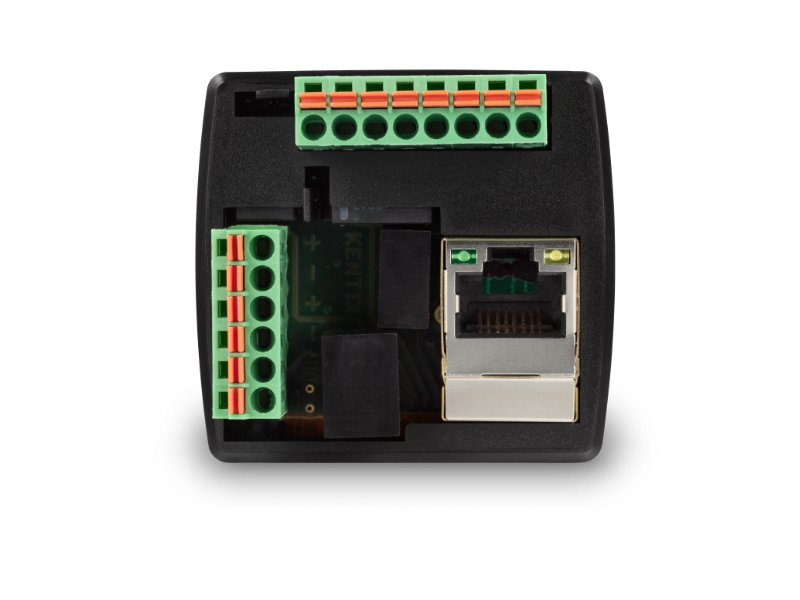
The Kentix PowerManager is the management unit for Kentix SmartPDU components and energy consumption meters with an RS-485 interface. The PowerManager is network-compatible and is supplied with voltage via Power over Ethernet (PoE).
The PowerManager can be operated as the main device (operating mode: Main Device) or in a network (operating mode: Satellite Device) with other PowerManagers. The KentixONE software is already integrated via the integrated web server (HTTPS). The configuration is done via web browser and depending on the operating mode (operating mode: Main Device) locally on the PowerManager itself or on a central instance like the SiteManager or AlarmManager (operating mode: Satellite Device).
The PowerManager can be mounted on a standard DIN rail or alternatively in a 60mm switch box.
The PowerManager is the central component of the solution. Here the SmartMeter or ModBus meters are connected via RS485 or LAN. The PowerManager is connected to the network via a PoE-capable switch.
Safety instructions
No modifications of any kind may be made to Kentix GmbH products, with the exception of those described in the relevant instructions.
When installing Kentix devices, certain degrees of protection must be guaranteed.
Observe the relevant regulations for installations in the respective environment.
Only operate the products within the defined temperature range.
The instructions should be passed on to the user by the person carrying out the installation.
Kentix accepts no liability for damage to the devices or components caused by incorrect installation. Kentix accepts no liability for incorrectly programmed units.
Kentix accepts no liability for faults, material damage or other damage.
moisture, dirt and damage during transportation, storage and operation.
Only operate the products within the defined temperature range.
Installation and battery replacement may only be carried out by trained specialist personnel in accordance with the instructions.
Do not charge, short-circuit, open or heat batteries.
Observe the correct polarity when inserting the batteries.
The devices must always be operated with the batteries intended for the product.
When changing the batteries, always replace all batteries.
Dispose of old or used batteries properly.
Keep batteries out of the reach of children.
Controls
Connection and operating elements
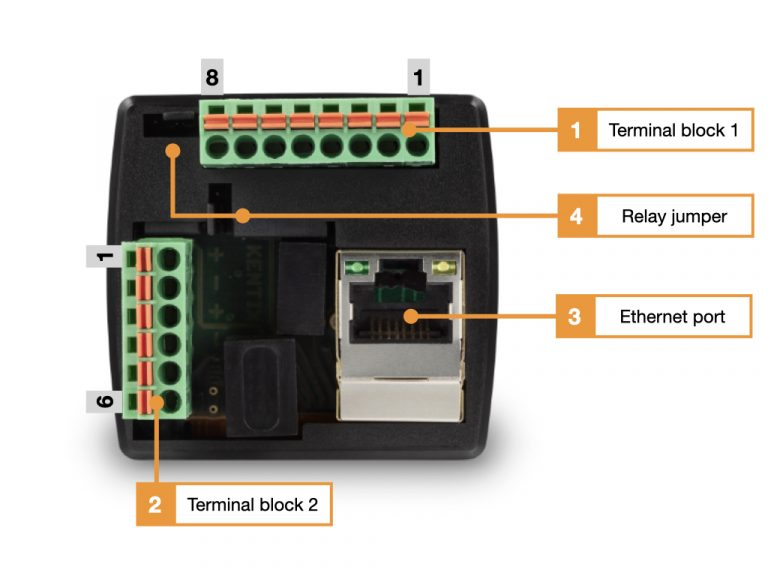
- Terminal block 1 (terminal 1-8, IO terminal with relay 1+2, digital input 1+2)
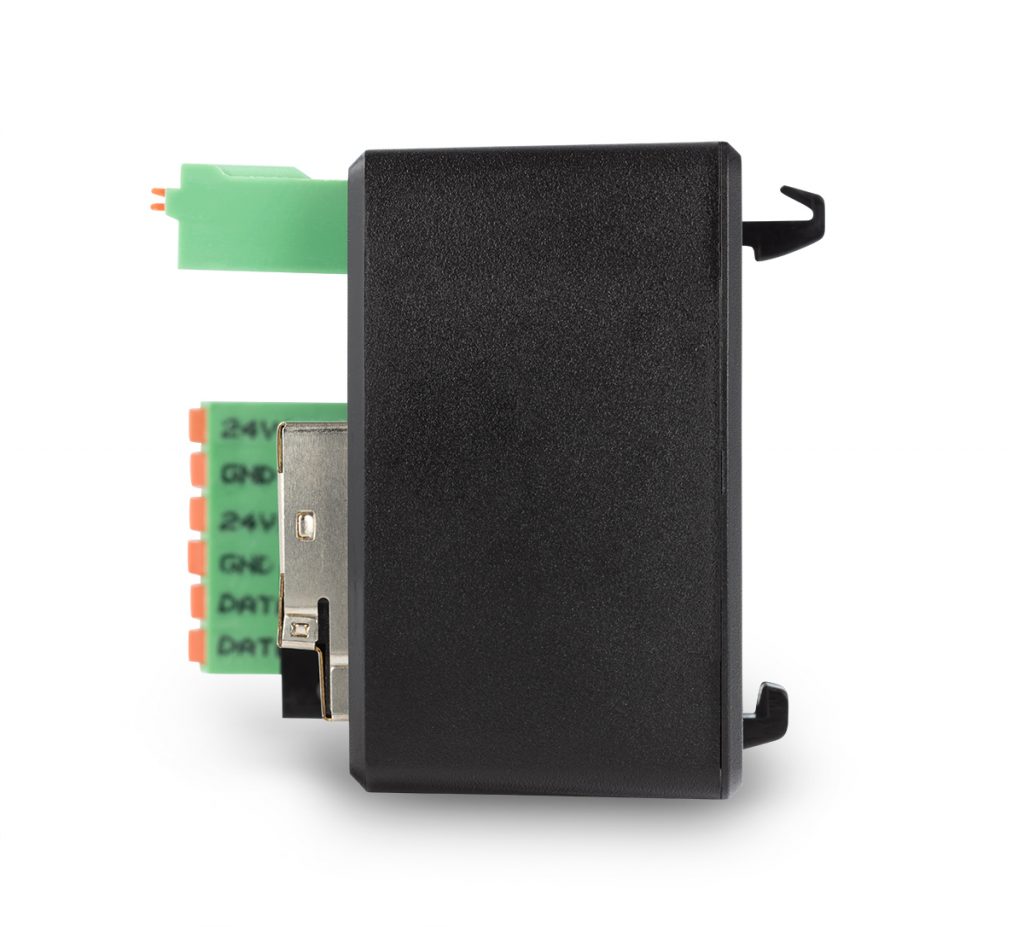
- Terminal block 2 (terminal 1-6, BUS-POWER-OUT terminal)
- Ethernet port with PoE power supply, Class 3 (12.95W)
- Jumper for switching the logic for relay output 1+2 (NC, NO)
| Terminal block 1 | Function connection |
|---|---|
| 1 | Digital input DI 1 (For potential-free wiring, e.g. door contact) |
| 2 | Digital input DI 1 (For potential-free wiring) |
| 3 | Digital input DI 2 (For potential-free wiring) |
| 4 | Digital input DI 2 (For potential-free wiring) |
| 5 | Relay 2 NO/NC (Default=NO) |
| 6 | Relay 2 COM (relay power max. 60VDC/1A) |
| 7 | Relay 1 NO/NC (Default=NO) |
| 8 | Relay 1 COM (relay power max. 60VDC/1A) |
| Terminal block 2 | Function connection |
|---|---|
| 1 | (+) 24VDC (power supply door opener, max. 0.5A) |
| 2 | (-) GND (power supply door opener, max. 0.5A) |
| 3 | (+) 24VDC (power supply RFID reader) |
| 4 | (-) GND (power supply RFID reader) |
| 5 | BUS-B (communication line to RFID reader) |
| 6 | BUS-A (communication line to RFID reader) |
Factory settings
For initial configuration, use the IP address printed on the device or the address assigned via DHCP in a web browser (HTTPS). Please note the network settings of your connected PC.
The factory IP addresses at a glance:
| SiteManager and AlarmManager | 192.168.100.222 |
| MultiSensor | 192.168.100.223 |
| AccessManager | 192.168.100.224 |
| PowerManager | 192.168.100.225 |
| SmartPDU | 192.168.100.226 |
| Leakage sensor | 192.168.100.227 |
Reset to factory settings
- Restart the device (disconnect and reconnect the power supply).
- The status LED lights up briefly and then goes out.
- As soon as the status LED lights up green continuously, press and hold the reset button for 15 seconds until the device emits an acoustic feedback.
- The device loads the factory settings and performs a restart.
- After approx. 2 minutes, the device can be reached with the factory settings.
Configuration with KentixONE
The device is configured via the web browser in KentixONE. The device must be accessible to the central KentixONE instance on the network side. Depending on the device type, a communication key and the IP address or DHCP name of the central KentixONE instance must also be set on the device (MultiSensors, AccessManager, SmartPDU). IP cameras or IO modules, on the other hand, can be integrated directly into KentixONE.
All information about the software can be found in the KentixONE section and the associated documentation.